
Most people have made a budget. Far fewer have kept one past February. The usual reason is not a lack of discipline. It is that the budget was written from hope rather than from what the money actually did, so the first normal month broke it. A budget you can keep starts with your real numbers and leaves room for real life.
Why most monthly budgets fail
They start from a guess, like $200 for groceries when you have spent $380 every month for a year. They have no room, so a birthday present or a parking fine blows the whole month. They are checked on the last day, when nothing can change. And one bad month gets read as proof that budgeting does not work.
Step 1: find out what you actually spend
Before you set a single limit, look back. Open the last three months of statements for every account you spend from, including cards, and sort each payment into a handful of categories: housing, utilities, groceries, transport, eating out, shopping, subscriptions. Add up each category and divide by three.
Three months smooths out one unusual month. If a figure surprises you, that is the point. If you have never kept a record of your spending, our guide to tracking your expenses compares doing it by hand, in a spreadsheet and in an app. Our guide to reading a bank statement explains each line, and the one on forgotten subscriptions shows where the quiet money hides.
Step 2: separate essentials from everything else
Mark the categories you cannot pause: rent or mortgage, utilities, phone and internet, groceries, transport to work, insurance, minimum debt payments and childcare. These are your essentials, and they get set first. Everything else is everyday spending: eating out, shopping, going out, hobbies, subscriptions. This is the part you are really budgeting, and where the choices are.
Step 3: decide what to keep before you decide what to spend
Pick an amount to keep each month and move it to savings on payday, before the everyday spending starts. If it waits until the end of the month, it rarely survives. Our guide to your savings rate helps you find a realistic number, and if you have no cushion yet, an emergency fund is the usual first goal.
Step 4: set a limit for each spending category
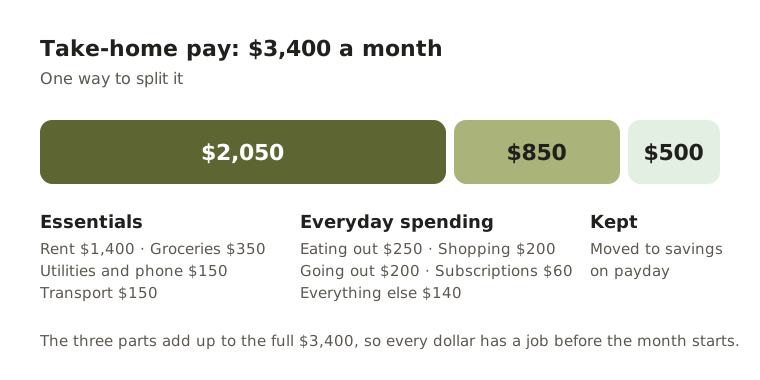
Now put the three parts together so they add up to your take-home pay. Say you bring home $3,400 a month. Your essentials from Step 1 come to $2,050. You decide to keep $500. That leaves $850 for everyday spending, split between the categories you found.
Two habits make the limits keepable:
- Set them near what you actually spent, then trim one or two categories a little. Cutting eating out from $320 to $250 is a change you can live with; $100 is one you will give up on.
- Keep an everything-else line. In the example that is $140 nobody has claimed. Gifts, repairs and the odd parking fine land there instead of breaking a category.
If the three parts do not add up, decide now rather than on the 25th: the everyday limits come down, the amount kept comes down for now, or an essential needs a longer-term fix, like a cheaper phone plan. If you would rather give every single dollar a named job until nothing is left over, our guide to zero-based budgeting takes that approach.
Step 5: check it once a week, not once a month
A budget is a plan for a month, but the checking needs to happen weekly. Pick a day, Sunday evening works for many people, and spend ten minutes on three questions:
- How much of each limit have I used so far?
- Is anything already close to its limit with half the month left?
- Is a bill due this week that I have forgotten about?
If eating out is at 80 percent of its limit on the 15th, you still have two weeks to cook a little more. That is what the weekly look is for.
When a month goes wrong
It will. If one category runs over every month, the limit is wrong, not you: raise it and lower another, or accept a smaller kept amount for now. If a one-off blew the month, note it and carry on. One bad month is data, not a verdict. And every three months or so, go back to Step 1 with fresh statements. Rent goes up, a subscription ends, a commute changes, and the budget should follow.
How Fimerse helps
In Fimerse, a budget is a monthly limit on a spending category, and each one shows how much of the limit the month's payments in that category have used. It is flagged when you reach 80 percent of the limit and marked over once you pass it, so you see trouble while there is still time to change it. Open a budget to change its limit.
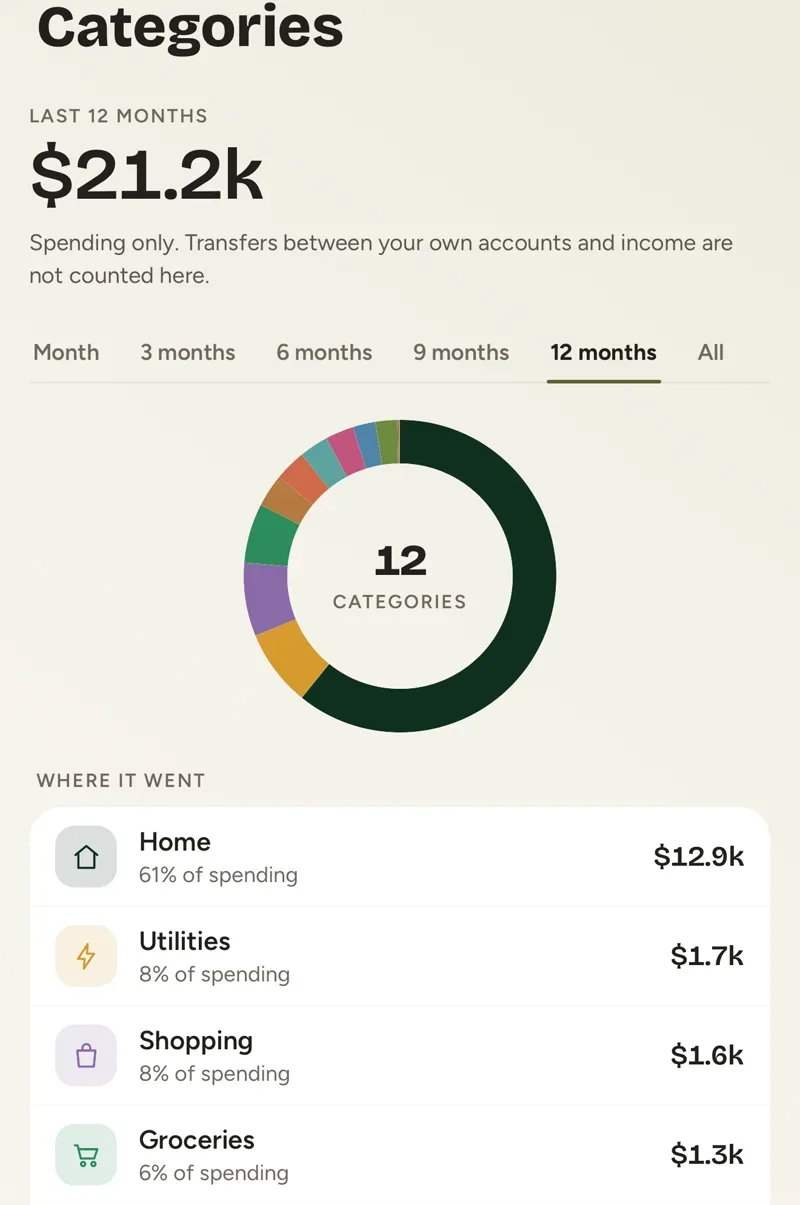
For Step 1, the Categories screen shows where the money went over the last 12 months by default, or over this month, the last 3, 6 or 9 months, all time, or any range you choose. Transfers between your own accounts are left out of spending, and you can make your own categories to match how you think about money.
Bills keep their due dates and remind you when one is due soon, and a payment that repeats month after month is offered to you as a bill. Budgets, bills, goals and payments typed in by hand are free. Having your bank statements read for you is part of Plus.
Questions people ask
Should I use the 50/30/20 rule?
The rule, half of take-home pay on needs, 30 percent on wants and 20 percent saved, is a reasonable starting shape when you have nothing else. Your real split will be different, especially where housing is expensive, and your own three months of statements are a better guide than any fixed percentage. Our guide to the 50/30/20 rule shows when and how to change the split.
What if my income is different every month?
Budget from your lowest realistic month rather than your average, and let good months fill a buffer. Our guide to budgeting on an irregular income goes through it step by step.
What if I share money with a partner?
The five steps are the same, but you first agree which costs are shared and how to split them. Our guide to budgeting as a couple covers joint and separate accounts and two fair ways to divide the bills.