
Most budgets set a few limits and hope the rest sorts itself out. A zero-based budget refuses to leave anything to hope. Every dollar that comes in is given a job before the month begins: rent, groceries, the emergency fund, a holiday, extra on the credit card. When the plan is finished, income minus everything you have assigned comes to zero. It suits anyone who wants to know exactly where every dollar is going.
What zero-based budgeting means
The zero is not your bank balance. Your account does not have to run dry at the end of the month. The zero is the gap between what you expect to receive and what you have planned to do with it. If you bring home $3,600, you write down jobs for $3,600, no more and no less. Saving is a job. Paying extra on debt is a job. Even "money I have not decided about yet" can be a job, as long as you have written it down and given it a figure.
Two things follow from that. First, you build the budget from what you actually spend, which means looking at your statements first. Second, you rebuild it every month, because December is not March and a budget written once in January rarely survives either.
A worked month
Say you take home $3,600 a month. You look at your last three months of statements, see what you really spent, and give the whole $3,600 a job:
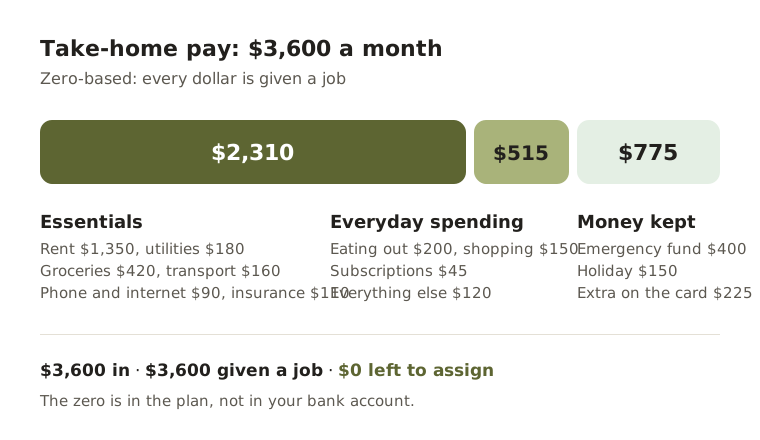
- Essentials, $2,310: rent $1,350, utilities $180, groceries $420, transport $160, phone and internet $90, insurance $110.
- Everyday spending, $515: eating out $200, shopping $150, subscriptions $45, everything else $120.
- Money kept, $775: emergency fund $400, holiday $150, extra credit card payment $225.
Add it up and the total is $3,600. Nothing is floating. If you had stopped after the essentials and everyday spending, $775 would have been sitting in your account with no plan, and money with no plan has a way of becoming shopping.
How to build one in five steps
- Start with what comes in. Use the amount that actually reaches your account after tax and deductions. If it varies, plan on your lowest realistic month and treat anything above it as extra to assign later.
- Write down the essentials first. Rent or mortgage, utilities, groceries, transport, insurance, childcare and the minimum payment on any debt. Take the figures from your last three statements, not from memory.
- Decide what to keep before you decide what to spend. Give your savings and extra debt payments a figure now, while there is still money to give. If you have no cushion yet, an emergency fund is the usual first job.
- Give everything else a limit. Eating out, shopping, subscriptions, hobbies, gifts. Set each one near what you really spent, then trim one or two a little.
- Assign until you reach zero. If money is left over, give it a job: more to savings, more to debt, or a sinking fund for a bill you know is coming. If you are below zero, the everyday limits come down first, then the amount kept, until the plan balances.
The whole exercise takes half an hour the first time and ten minutes once you have done it twice, because most of the jobs repeat from one month to the next.
Keeping it going during the month
A zero-based budget is a plan, and plans meet reality. Two habits keep it alive.
Move money between jobs instead of giving up. If groceries run to $470 instead of $420, take the $50 from eating out or from the everything-else line and write it down. The total still comes to zero; only the jobs have changed. That is the method working, not failing.
Check it once a week. Pick a day and spend ten minutes on three questions: how much of each limit is used, is anything already close with half the month left, and is a bill due this week. At 80 percent of a limit on the 15th there is still time to change something.
Zero-based or 50/30/20?
They answer different questions. The 50/30/20 rule gives you the shape of a month in three numbers and asks for very little effort. Zero-based budgeting gives you a line for every job and asks for a monthly session with your statements. If you want a quick sanity check, start with the rule. If you want to know where every dollar went and why, go zero-based. Many people run both: the rule to set the size of the three buckets, the zero-based plan to fill them in.
How Fimerse helps
Fimerse works from your own payments, so the first step, finding out what you really spend, is where it earns its place. The Categories screen shows where the money went over the last 12 months by default, or over this month, the last 3, 6 or 9 months, all time, or any range you choose. Transfers between your own accounts are left out of spending, and you can make your own categories to match the jobs in your plan.
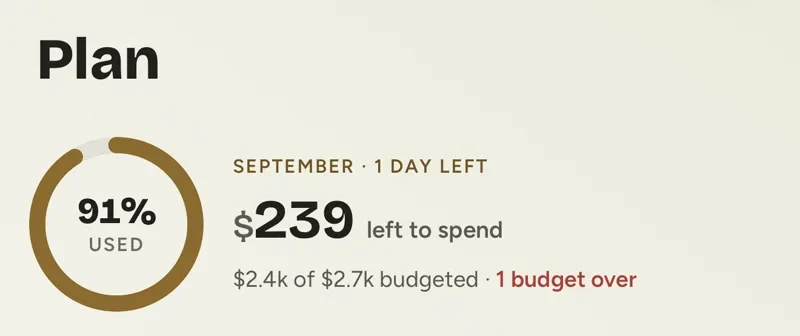
Then give each spending category a budget, a monthly limit. Each budget shows how much of the limit the month's payments have used, is flagged when it reaches 80 percent and marked over once it passes it. The Plan screen on the phone adds everything up and shows how much of all you budgeted this month is used and what is left to spend.
Savings goals keep the jobs for money you are keeping: make a goal, add funds to it as you save, and watch it fill. Fimerse records what you tell it but never moves money for you. Bills keep their due dates and remind you when one is due soon, and a payment that repeats month after month is offered to you as a bill. Budgets, goals, bills and payments typed in by hand are free. Having your bank statements read for you is part of Plus.
Questions people ask
Does my account have to hit zero?
No. The zero is in the plan, not the account. Money assigned to savings or to next month's bills still sits in your account until it is used. Many people deliberately keep a small buffer in the current account and treat it as one of the jobs.
What if I am paid every two weeks or my income changes?
Plan the month on the paycheques you are sure of, and when the extra one or the better month arrives, give that money a job too, usually savings or debt. Our guide to budgeting on an irregular income goes through it in detail.
Do I have to rebuild it every month?
Yes, and that is the point. Most lines carry over unchanged, so it takes ten minutes, but the session is where you notice the subscription that crept up, the bill that is due this month and not last, and the category that keeps running over.