
Some of the biggest bills of the year are not surprises at all. The car insurance renews in the same month every year. The holidays fall on the same dates. The laptop is four years old and slowing down. Yet when these costs land, they often feel like emergencies, because nothing was put aside for them. A sinking fund fixes that by spreading a known cost over the months before it arrives.
What a sinking fund is
A sinking fund is money you set aside, a little at a time, for one specific expense with a rough date. Each fund has three things:
- A purpose, such as "car insurance" or "holiday gifts".
- A target, the amount you expect to pay.
- A date, when the money will be needed.
Divide the target by the number of months left, and you have the amount to save each month. When the bill comes, you pay it from the fund, and your normal monthly budget barely notices.
Sinking fund or emergency fund?
They sound alike, but they do different jobs. An emergency fund is for things you cannot predict: a lost job, an urgent repair, a medical bill. A sinking fund is for things you can.
Keeping them apart matters. If the annual insurance bill comes out of the emergency fund, the fund is smaller when a real emergency happens. Sinking funds protect the emergency fund by catching the predictable costs first.
Step 1: list the costs you can see coming
Go through a year in your head, month by month, and write down every cost that does not come every month. Your past bank statements are the best memory aid: look back over the last twelve months for large or unusual payments. Common ones:
- Car insurance, registration, servicing and new tyres.
- Home or renters insurance paid once a year.
- Holiday and birthday gifts.
- Travel and holidays.
- Annual subscriptions and memberships.
- Replacing things that wear out: a phone, a laptop, glasses.
You do not need a fund for everything. Start with the three or four costs that hurt the most when they arrive.
Step 2: work out the monthly amount
For each cost, take the amount and divide it by the months until it is due.
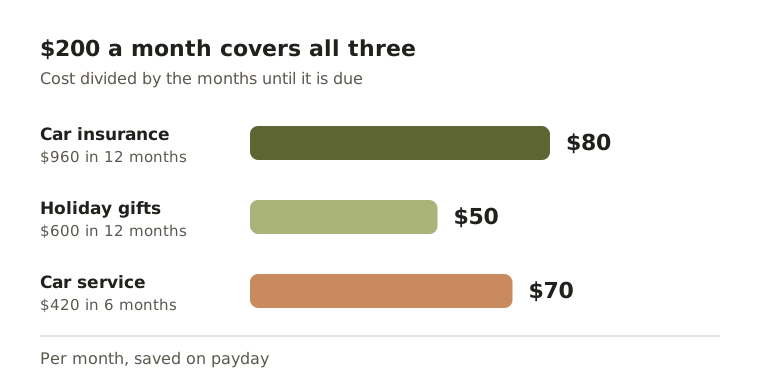
- Car insurance of $960, due in 12 months: $960 / 12 = $80 a month.
- Holiday gifts of $600, needed in 12 months: $600 / 12 = $50 a month.
- A car service of $420, due in 6 months: $420 / 6 = $70 a month.
Together that is $200 a month.
If a bill is closer than you would like, the monthly amount will be high. That is fine for the first year. Save what you can now, and next year start twelve months ahead.
Step 3: decide where the money lives
The money needs to be kept apart from your everyday spending, or it will quietly get spent. Options that work:
- Separate savings pots. Many banks and money apps let you open several savings pots or accounts and give each one a name. One pot per fund makes the balances easy to read.
- One savings account with a list. Keep all sinking funds in a single account and track how much of the balance belongs to each fund in a note, a spreadsheet or an app.
Either works. Which account or interest rate suits you is your call; if you are unsure, ask a professional.
Step 4: add it to your budget
A sinking fund only works if the monthly amount is part of the plan, not whatever is left over. In a zero-based budget, each fund is a line that gets its money before the month starts. In a monthly budget of any kind, treat the total like a bill that comes out on payday.
Setting up a recurring transfer at your bank on the day you are paid takes the decision out of it.
Step 5: spend it, then start again
When the bill arrives, pay it from the fund. That is the whole point, so do it without guilt. Then reset the fund for next year, check whether the cost has changed, and carry on.
If a fund ends with money left over, move it to another fund or to your savings. If it comes up short, top it up this time and raise the monthly amount next year.
How Fimerse helps
Fimerse lets you add savings goals with a name and a target amount, then add funds to each one as you save, with a progress ring showing how close you are.
You can also add each big cost as a bill with its due date, and the app reminds you a few days before it is due. The spending breakdown by category can look back over the last 12 months, which is where yearly costs show up. Goals, bills and accounts you type in by hand are free; reading your bank statements for you is part of Plus.
Questions people ask
How many sinking funds should I have?
As many as you can keep track of. Most people do well with three to six. Too many small funds can make the budget harder to follow, so group similar costs, like all car costs in one fund.
Should I pay off debt or fill sinking funds first?
That depends on your situation, and this guide cannot give personal advice. A sinking fund for a bill you must pay can stop you borrowing to cover it. If you are weighing the two, a financial adviser can help.