
If you have ever looked for a simple way to budget, you have probably met the 50/30/20 rule. It was popularised by Elizabeth Warren and Amelia Warren Tyagi in their book All Your Worth, and it lasts because it asks for only three numbers instead of twenty categories. That simplicity is its strength, and also the reason it needs adjusting for most people.
What the 50/30/20 rule says
Take your monthly take-home pay, the amount that actually lands in your account after tax and deductions, and divide it three ways:
- 50 percent for needs: the things you cannot pause without real harm. Rent or mortgage, utilities, groceries, insurance, transport to work, childcare and the minimum payment on any debt.
- 30 percent for wants: everything you choose. Eating out, shopping, streaming, holidays, hobbies, the nicer version of a need.
- 20 percent for savings and debt: money set aside for an emergency fund, a goal or retirement, plus anything you pay on debt above the minimum.
The rule does not tell you what to spend on wants or how to save. It only sets the size of each bucket, so you can see at a glance whether the shape of your month is reasonable.
A worked example
Say you take home $4,000 a month. The rule gives you $2,000 for needs, $1,200 for wants and $800 to keep.
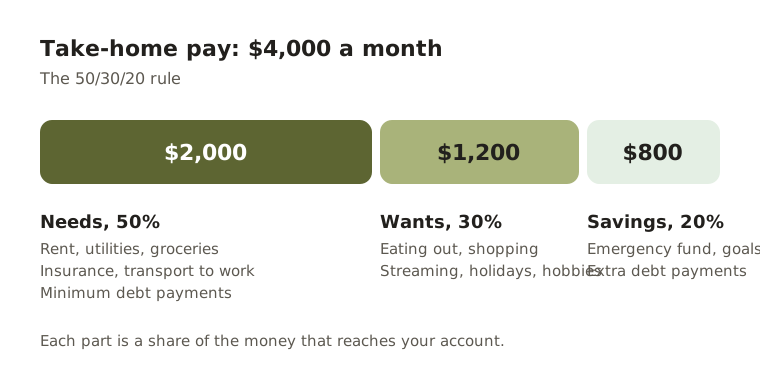
Now compare that with what really happened. Open your last three months of statements, sort each payment into needs or wants, and take the average. If your needs come to $1,850, you are inside the rule and have $150 of room. If they come to $2,400, the rule is telling you something, and the next sections are about what to do with it.
Needs or wants: the grey areas
Most arguments about the rule are about where things belong. A few honest tests help:
- Would it cause real trouble if it stopped next month? Rent, yes. A gym membership, usually no.
- Split the upgrade. Basic groceries are a need; the premium delivery service on top is a want. A phone plan is a need; the newest handset is a want.
- Minimum debt payments are needs. Extra payments go in the 20 percent, because they do the same job as saving.
You will not get every line perfect, and you do not need to. The aim is a split that is roughly right, not a perfect ledger.
When to change the split
The rule was written as a guide for an average household, and many people are not average. Changing the split is not cheating. It is using the rule properly.
When housing is expensive
In cities like London, New York or Dublin, rent alone can take half of take-home pay. If you bring home £2,800 and rent is £1,300, needs will land nearer 60 percent than 50. A 60/25/15 split is a fair plan here: cover the needs, trim the wants a little, and keep saving something every month, even if it is less than 20 percent.
When you have high-interest debt
If you carry a credit card balance, putting more than 20 percent toward it can make sense, taking it from wants for a while. Paying off high-interest debt and saving both move you forward. For anything beyond that, such as which debt to clear first, ask a professional.
When your income changes month to month
Freelancers and anyone paid by the shift can run the rule on their lowest realistic month and let good months top up savings. Our guide to budgeting on an irregular income goes through it.
When you can save more
If your needs are well under half, there is no rule saying wants must fill the gap. A 40/30/30 or even 40/20/40 split builds savings faster. Our guide to your savings rate shows how to see what you actually keep.
From three buckets to a real budget
The rule gives you three totals. To make them work day to day, break the needs and wants into the categories you actually spend in, and give each a monthly limit that adds up to the bucket. Our guide to making a monthly budget walks through that step by step. If you would rather name a job for every single dollar, zero-based budgeting takes the three buckets all the way down.
Move the 20 percent on payday, before the month's spending starts. Money that waits until the end of the month to be saved usually gets spent. If you have no cushion yet, an emergency fund is the usual first home for it.
How Fimerse helps
Fimerse does not use fixed percentages. It works from your own payments, which makes it a good way to check the rule against reality.
The Categories screen shows where your money went over the last 12 months by default, or over this month, the last 3, 6 or 9 months, all time, or any range you choose. Add up the categories you count as needs and those you count as wants, and you have your real split. Transfers between your own accounts are left out of spending, and you can make your own categories to match how you think about money.
Then set a budget, a monthly limit, on each category. A budget is flagged when it reaches 80 percent of its limit and marked over once it passes it. The Transactions screen shows how much came in, how much went out and how much was kept over the month or period you choose, which is your real savings slice.
Budgets and payments typed in by hand are free. Having your bank statements read for you is part of Plus.
Questions people ask
Is the 50/30/20 rule based on gross or take-home pay?
Take-home pay, the amount that reaches your account. Tax and anything taken from your pay before it arrives are not part of the three buckets.
What if I cannot save 20 percent?
Save what you can, even 5 percent, and make it automatic. A smaller amount saved every month beats a bigger amount that never happens, and you can raise it as needs come down or income goes up.