
Your income tells you how much money arrives. Your savings rate tells you how much of it stays. It is one of the most useful single numbers in personal finance because it works the same for every income: a higher number simply means more of each paycheck is being kept.
The formula
Savings rate = (money in minus money out) divided by money in, times 100.
Money in minus money out is what you kept. So another way to say it: savings rate is the share of your income you kept.
A worked example
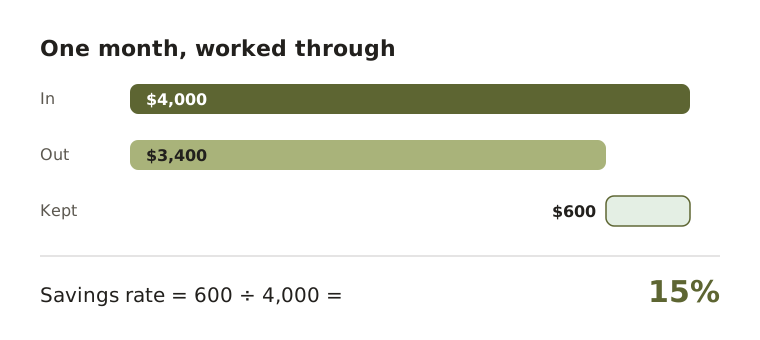
Say this happened in March:
- Money in: $4,000 in take-home pay.
- Money out: $3,400 across rent, groceries, transport, bills and everything else.
- Kept: $4,000 minus $3,400, which is $600.
Savings rate: 600 divided by 4,000 is 0.15, or 15 percent.
Choices that change the number
There is no single official definition, so decide how you will count and then stay consistent. Comparing months counted in different ways tells you nothing.
Take-home pay or gross pay
Most people use take-home pay, the money that actually arrives in their account. If you use gross pay, taxes count as money out and the rate will look lower. Either works if you always use the same one.
Money moved to savings
Moving money from your current account to your savings account is not spending, so it should not count as money out. That money is part of what you kept, whether it goes toward a holiday or an emergency fund.
Retirement contributions taken from your pay
If your employer takes pension or retirement contributions before your pay arrives, those are savings you never see. Some people add them to both money in and kept to get a fuller picture. Decide once and note it down.
Look at the trend, not one month
A single month can swing a lot: an annual bill, a holiday, a bonus. Looking at your savings rate over the last six or twelve months shows whether you are actually keeping more over time. If your income varies, our guide to budgeting on an irregular income shows how to read uneven months.
How Fimerse calculates it
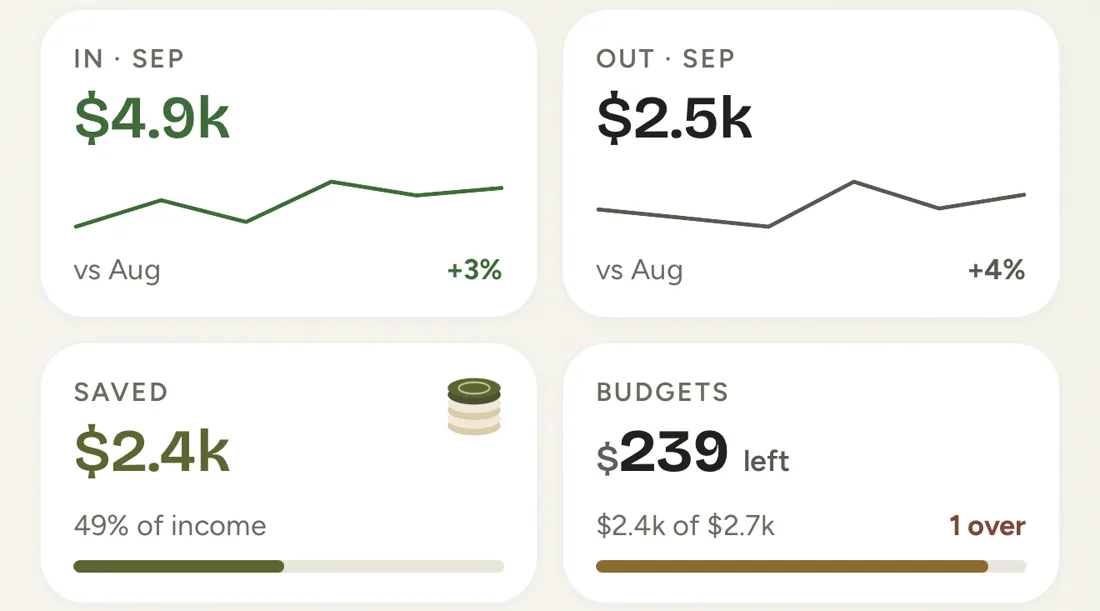
Fimerse shows your savings rate on Home, worked out only from your real transactions. Transfers between your own accounts are left out of both sides so they do not distort it, and anything still waiting for you to review is not counted as income or spending until you decide. Each month also shows In, Out, Kept side by side, so you can see what moved the rate.
Questions people ask
What is a good savings rate?
It depends on your income, costs, age and goals, so there is no number that is right for everyone. The most useful comparison is with your own past months: a rate that is rising is a good sign.
Can my savings rate be negative?
Yes. If you spent more than came in, perhaps by using savings or a credit card, the rate is below zero for that month. One negative month is common; several in a row are worth a closer look.