
Net worth sounds like a number for wealthy people, but it is the simplest summary of anyone's finances. It can be negative, especially early on with student loans or a new mortgage, and that is normal. What matters is the direction it moves over time.
Step 1: List what you own
These are your assets. Write each one down with its current value:
- Cash, including any you keep at home or in a wallet.
- Bank balances: current accounts, savings accounts and money in apps like Wise or Revolut.
- Investments and retirement accounts, at their current value.
- Property, at a realistic estimate of what it would sell for today.
- Large items you could sell, such as a car, if you want to include them. Many people leave these out because they lose value quickly.
Step 2: List what you owe
These are your liabilities:
- Credit card balances.
- Personal loans, car loans and buy now pay later balances.
- Student loans.
- What is left on your mortgage.
- Money you owe to friends or family, if you want the full picture.
Step 3: Subtract
Net worth = what you own minus what you owe. Our free net worth calculator does the sum for you as you type.
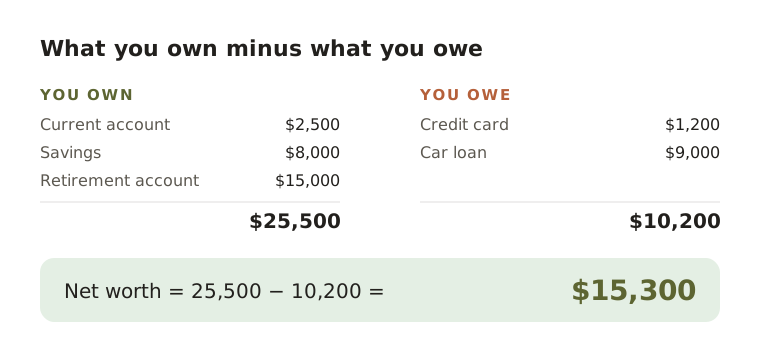
For example: $2,500 in a current account, $8,000 in savings and $15,000 in a retirement account make $25,500 owned. A $1,200 credit card balance and a $9,000 car loan make $10,200 owed. Net worth is $25,500 minus $10,200, which is $15,300.
Accounts in more than one currency
If you hold money in different currencies, convert everything into one currency before you add it up, at the same date's exchange rate. Pick the currency you think in, usually the one you are paid or spend most in, and use it every time. Our guide to tracking money in more than one currency covers this in more detail.
Update it once a month
Recalculate on the same day each month and keep the history. The trend is what you are after: paying down a card, building savings and a growing retirement account all show up as a line that slowly rises.
How Fimerse shows it
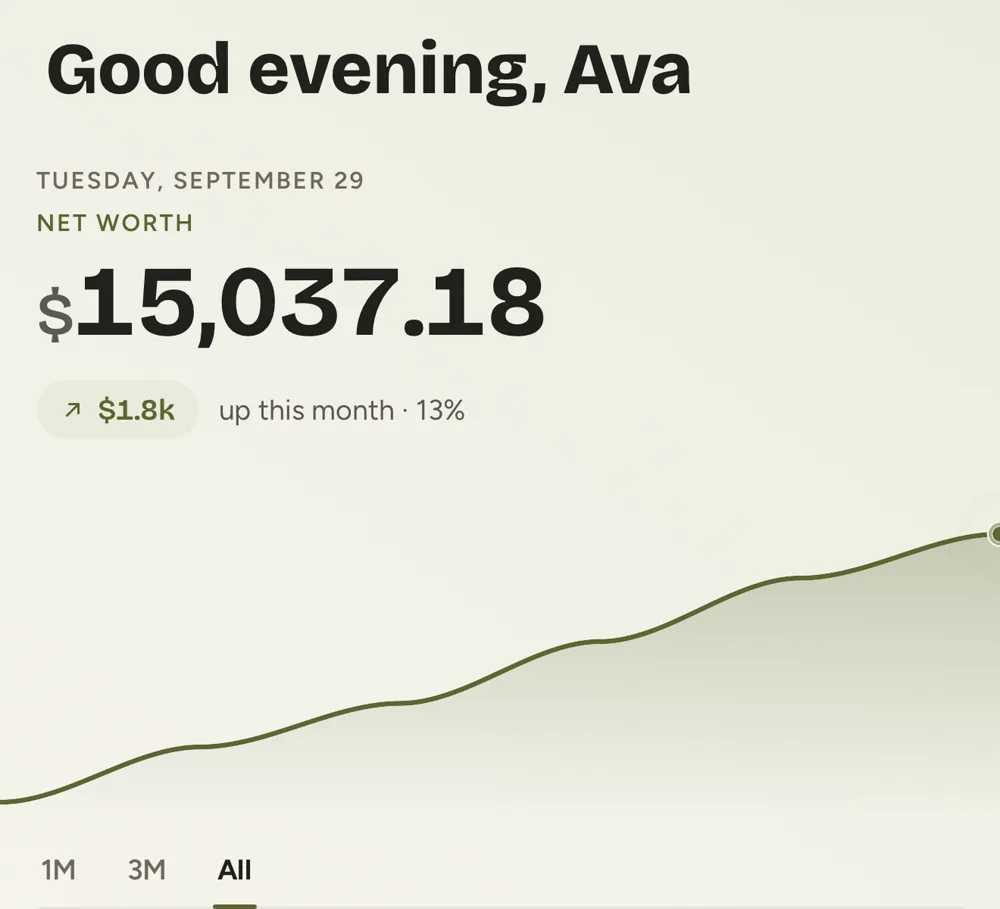
Fimerse puts your net worth at the top of Home, calculated from the balances of the accounts you track, with a small trend beside it. Each account keeps its own currency, and the total is shown in the currency you choose, converted at today's rates, with an optional second currency underneath.
Questions people ask
Should I include my house?
If you own one, yes, at a realistic value, along with the mortgage you still owe on it. Some people track net worth with and without their home, since a home is hard to turn into cash quickly.
Is a negative net worth bad?
It is common, especially early in a career or soon after buying a home. A negative number that is getting less negative each month is real progress.