
Many people now have money in more than one currency: freelancers paid by clients abroad, people who moved country and kept an account at home, travellers with a Wise or Revolut card. Most budgeting tools assume one currency, which turns tracking into constant mental arithmetic. A few simple rules fix that.
Rule 1: Each account keeps its own currency
A euro account holds euros. Do not convert its balance into dollars when you write it down; record it in euros. Converting at entry time locks in that day's rate, and a month later your records no longer match your bank.
Rule 2: Record each payment as it happened
A payment of 45 euros is 45 euros. Write down the amount and the currency it was made in. If your card converted it, your statement may show both the original amount and the amount charged to your account; record the amount that left your account, in that account's currency.
Rule 3: Pick one currency to think in
Choose the currency you use to judge whether something is expensive, usually the one you earn or spend most in. This is your home currency for totals. Every summary, net worth and monthly total is shown in it.
Rule 4: Convert only when you add up
When you want a total, convert each account at the same day's rate and add them together. This keeps the underlying records exact while giving you one number to look at.
Watch out for these
- Fees hidden in the rate. Banks and card providers often add a margin to the exchange rate or a separate foreign transaction fee. Compare the rate you got with the market rate on the same day to see what a conversion really cost; the guide on foreign transaction fees shows how to find and avoid them.
- Moving money between your own accounts in different currencies. Sending dollars to your own euro account is a transfer, not spending, even though the amounts on each side differ. Count any fee as spending, not the transfer itself.
- Rate swings. Your total can rise or fall when rates move even if you did nothing. When a month looks strange, check whether the rate changed.
How Fimerse handles currencies
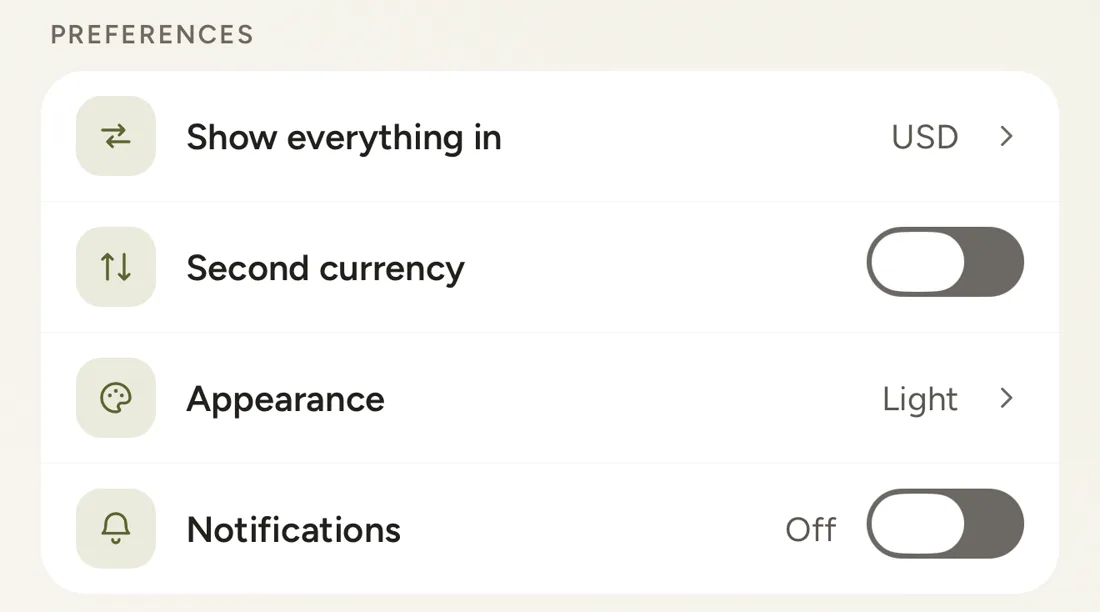
Fimerse supports more than 140 currencies. Every account keeps its own currency and every payment keeps the currency it was made in. Your totals are shown in the currency you choose in Settings, converted at live rates, with an optional second currency shown underneath if you think in two. There is a currency converter in the app for quick checks. Statements from banks in any country can be read on Plus, and a cash wallet in local money can be added and filled by hand for free. If you are a freelancer paid in several currencies, the page Fimerse for freelancers shows how this fits together.
Questions people ask
Which exchange rate should I use?
For tracking, a published mid-market rate for the day is fine and is what most tracking tools use. For what a conversion actually cost you, use the amount that left one account and arrived in the other.
Should I convert all my savings into one currency?
That is a financial decision that depends on where you live, spend and plan to be, and this guide does not cover it. For tracking, it does not matter: keep each balance in its real currency and convert only in the totals.