Living and working on the move makes money harder to see. Your income may arrive in dollars while you pay rent in euros and buy coffee in pesos. Your bank at home may not work with the budgeting app you want to use. And half your spending might be in cash. None of that makes budgeting impossible; it just needs a slightly different setup.
Step 1: Choose your home currency
Pick one currency to judge everything in, usually the one you earn in. Your monthly budget, your totals and your goals are all set in it. Without one fixed reference, every price feels either cheap or expensive depending on the day.
Step 2: Track each account in its own currency
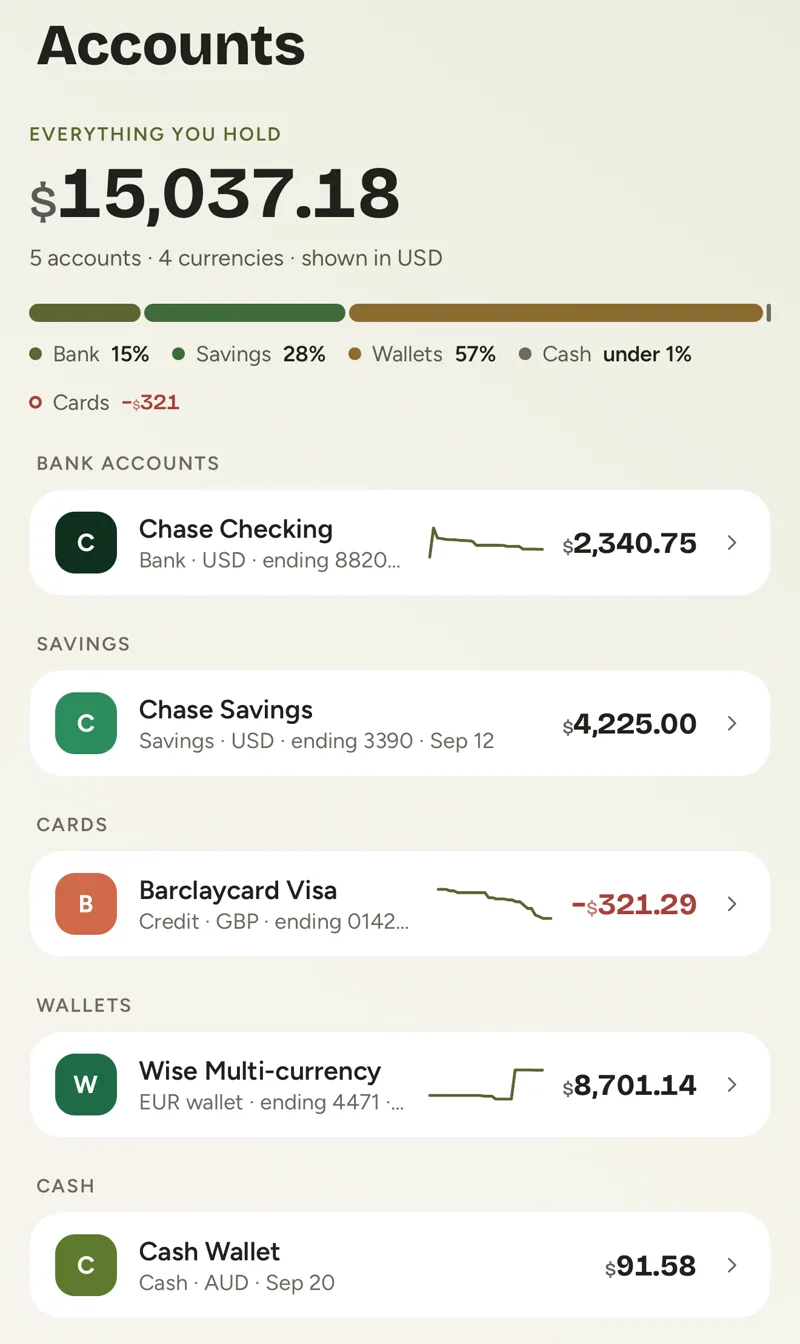
Your bank at home, a Wise or Revolut account with several balances, a local account if you open one, and cash: keep each in the currency it actually holds. Convert only when you look at the total. Our guide to tracking money in more than one currency explains why this keeps your records accurate.
Step 3: Budget each place from its real costs
The cost of living changes a lot from one city to the next. Before you arrive, or in your first week, note the big costs: accommodation, coworking or internet, local transport, groceries and eating out. Convert them to your home currency and set that month's budget from those numbers, not from your last stop.
Step 4: Keep a moving fund
Flights, visas, deposits, travel insurance and the occasional double rent when places overlap are the costs that break a nomad budget. Put a fixed amount into a separate moving fund every month, so a transition is already paid for when it comes.
Step 5: Do not lose the cash
In many countries cash is still the easiest way to pay. Cash withdrawals show up on your statement as one lump, which hides what you actually spent it on. Track cash as its own wallet in local money, and note larger cash payments as you make them. Our guide to keeping track of cash spending has a simple routine.
Step 6: Watch the fees
Foreign transaction fees, ATM fees and poor exchange rates add up quietly. Look for them on your statements each month, and if they are significant, compare cards and accounts that charge less for spending abroad.
How Fimerse fits a nomad life
Fimerse works with your bank at home from anywhere: download a statement and, on Plus, Fimerse reads it, whatever country the bank is in. Every account keeps its own currency, more than 140 are supported, and your totals are shown in the currency you choose at live rates. A cash wallet in local money can be added and filled in by hand for free, in a few seconds, including by voice. More on how it works for people on the move is on Fimerse for digital nomads.
Questions people ask
Should I open a bank account in every country?
Usually not. A good multi-currency account plus your home bank covers most needs. A local account can help if you stay somewhere for a long time or are paid locally, but it depends on the country's rules for foreigners.
How do I handle tax as a nomad?
Tax for people who move between countries is complicated and depends on your citizenship, residence and where your income comes from. Talk to an accountant who works with nomads or expats before you assume anything.