
A statement looks dense, but every bank's version is made of the same few parts. Once you know them, a month takes a few minutes to read. (A card statement works a little differently; see how to read a credit card statement.)
The parts of a statement
The header
Your name and address, the account name, and the account details (in the US an account and routing number, in the UK a sort code and account number, in Europe an IBAN). It also shows the statement period, for example 1 to 30 September.
Opening and closing balance
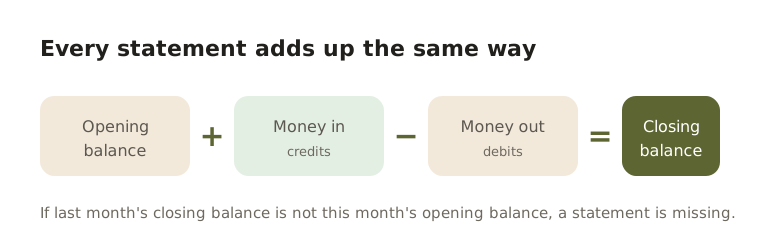
The opening balance is what was in the account at the start of the period; the closing balance is what was left at the end. The opening balance should match the closing balance on last month's statement. If it does not, a statement is missing.
The summary
Many banks add a short summary: total money in (credits or deposits), total money out (debits or withdrawals), and sometimes fees and interest. Opening balance, plus money in, minus money out, equals the closing balance.
The transaction list
One line per transaction, usually with:
- Date: often the date the payment cleared, which can be a day or two after you paid.
- Description: the name of the business or person, sometimes shortened or written in capitals with a reference number.
- Amount: money out and money in, either in separate columns or as one column with negatives for money out.
- Running balance: what was in the account after that line.
The short codes next to payments
Banks label payment types with abbreviations. They vary by bank and country, but common ones include DD (direct debit), SO (standing order), POS or card (a card payment in a shop or online), ATM (a cash withdrawal), ACH (a US bank transfer) and FPI or FPO (a UK faster payment in or out). Your bank's help pages list its own codes.
What to check every month
- Every line is yours. An unfamiliar description is usually a business trading under a different name, but if you cannot place it, ask your bank.
- Regular payments. Subscriptions and memberships repeat on the same day each month. Make sure each one is something you still use. Our guide to finding forgotten subscriptions covers this.
- Fees and interest. Overdraft fees, foreign transaction fees and interest charges are easy to miss and worth questioning.
- Transfers between your own accounts. These are not spending. Leave them out when you add up what the month cost.
- Money in. Check salary and client payments arrived in full.
Turning a statement into a picture of your month
Reading a statement tells you what happened. Sorting it into categories tells you what it means: how much went on housing, food, transport and the rest, and what you kept. You can do that in a spreadsheet, or let Fimerse do it. On Plus you upload the statement (PDF, photo, CSV or text) and every line is listed and sorted for you, with anything uncertain left for you to decide rather than guessed. The file is deleted once it has been read.
Questions people ask
Why is the date on my statement different from the day I paid?
Card payments are often shown on the date they cleared, which can be one to three days after the purchase. Some banks show both dates.
How long should I keep bank statements?
It depends on what you need them for, especially taxes, and the rules differ by country. Your bank keeps them available online for a period too. If you are unsure, ask an accountant or check your tax authority's guidance.