
A bank statement shows your own money going in and out. A credit card statement shows money you borrowed during the month, what the card company wants back, and by when. Four numbers at the top tell you most of what you need.
The four numbers that matter most
Statement balance
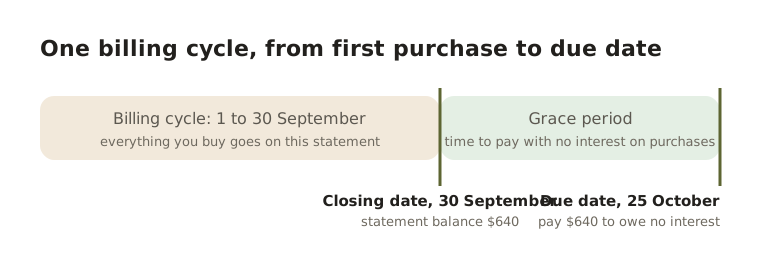
What you owed on the day the billing cycle closed. Some cards call it the new balance. It is the amount to pay if you want to clear the month in full.
Minimum payment
The least you must pay by the due date to keep the account in good standing. It is usually a small part of the balance, and interest is charged on whatever you leave unpaid.
Payment due date
The day your payment has to arrive. Miss it and most cards charge a late fee.
Closing date
The last day of the billing cycle, also called the statement date. Anything you buy after it goes on next month's statement.
Statement balance and current balance are not the same
Your card's app or website also shows a current balance. That is everything you owe right now, including purchases made since the closing date. If your September statement says $640 and you have spent $90 since, the current balance is $730. To avoid interest you only need to pay the $640 by the due date. The $90 will be on the next statement.
How interest works
Most cards give you a grace period on purchases: the time between the closing date and the due date. In the US, the Consumer Financial Protection Bureau explains that if your card has a grace period and you pay the full balance by the due date, you avoid interest on new purchases. If you pay less than the full balance, you are charged interest on the unpaid part, and new purchases start to collect interest from the day you make them.
Two lines on the statement show what borrowing costs:
- APR (annual percentage rate): the yearly interest rate. A card can have more than one, for example one for purchases and a higher one for cash advances.
- Interest charged: the actual amount of interest added this cycle. If you paid last month in full, it is normally zero.
Cash withdrawals on a credit card are different. They usually have no grace period, so interest starts on the day you take the cash, often with a fee on top.
The rest of the page
- Credit limit and available credit. The limit is the most you can owe at once. Available credit is the limit minus what you owe now.
- Previous balance, payments and credits. What you owed last time, what you paid, and any refunds. A refund shows as a credit and lowers the balance.
- Transactions. One line per purchase, with the date, the business name and the amount. Many cards show two dates: the day you paid and the day the charge was posted to the account.
- Fees. Late fees, annual fees and foreign transaction fees are listed separately from purchases.
- Minimum payment warning. US statements include a short table showing how long it would take to clear the balance, and what it would cost, if you paid only the minimum each month.
What to check every month
- Every charge is yours. A name you do not know is often a business trading under another name. If you still cannot place it, call your card company.
- Nothing appears twice. The same amount at the same business on the same day is worth a second look.
- Subscriptions. Many subscriptions are billed to a card. Our guide to finding forgotten subscriptions shows how to go through them.
- Fees and interest. If you were charged interest and expected none, check whether last month's payment covered the full statement balance.
If a charge is wrong, act quickly. In the US, the CFPB says to call the card company and then send a written notice within 60 days of the charge appearing on your statement. Rules in other countries differ, so check with your card company.
Keep the card out of your spending twice
When you add up what a month cost, count the purchases on the card, not the payment you send to the card company. That payment only settles purchases you have already counted. Treat it like a transfer between your own accounts.
How Fimerse helps
A credit card can be its own account in Fimerse, next to your bank accounts. On Plus you can upload the card statement as a PDF, a photo, a CSV or a text file, and Fimerse reads every transaction and sorts it into a category. Anything it is unsure about waits in a review queue for you to answer rather than being guessed, and payments that look like duplicates are flagged for you to keep or remove. The file is deleted once it has been read.
A payment from your bank account to your card can be linked as a transfer, and linked transfers are left out of your spending totals, so the same money is not counted twice. If you prefer, typing payments in by hand is free.
Questions people ask
Should I pay the statement balance or the current balance?
Paying the statement balance by the due date is enough to avoid interest on purchases on most cards. Paying the current balance clears newer purchases too, but it is not required.
What happens if I only pay the minimum?
Your account stays in good standing, but interest is charged on the rest and the debt takes much longer to clear. The minimum payment warning on a US statement shows how long. If you are struggling to pay more than the minimum, talk to your card company or a non-profit debt adviser.