
Money is easier to manage alone. Nobody questions your coffee habit, and nobody else's spending surprises you. With two people there are two incomes, two sets of habits and one rent. A couple's budget is less about arithmetic than about agreeing a few rules once, so that you do not have to negotiate every bill as it arrives.
Start by agreeing what is shared
Before you talk about accounts, write down which costs belong to both of you. For most couples who live together the list looks like this:
- Rent or mortgage, and home insurance.
- Utilities, internet and shared subscriptions.
- Groceries and household supplies.
- A shared car, or shared transport costs.
- Children and pets.
- Holidays and savings goals you are working on together.
Everything else is personal: your own clothes, hobbies, lunches, gifts and any debts you brought with you. Where the line sits is your choice. What matters is that you both know where it is.
Three ways to set up your accounts
Everything joint
Both incomes land in one account and everything is paid from it. It is the simplest to track, because there is one balance and one statement. It works best when you already think of all the money as "ours", and it needs trust, because every purchase is visible to both of you.
Everything separate
Each of you keeps your own account and you split bills as they come, or one pays the rent while the other covers groceries and utilities. You keep full independence, but someone has to keep score, and it is easy to lose track of who has paid for what.
Yours, mine and ours
Each of you keeps a personal account, and you open one joint account for the shared list. On payday you each move your agreed share into it, and every shared bill comes out of it. Many couples settle here: shared costs are paid without any scorekeeping, and the money left in your own account is yours to spend.
Two fair ways to split the shared costs
Say Alex takes home $4,200 a month and Sam takes home $2,800. Their shared costs come to $3,000 a month.
Half each. Each pays $1,500. It is simple, and it feels fair when your incomes are close. Here they are not: $1,500 is about 36 percent of Alex's pay and about 54 percent of Sam's.
In proportion to income. Together they bring home $7,000. Alex earns 60 percent of that and Sam 40 percent, so Alex pays 60 percent of the shared costs and Sam pays 40 percent:
- Alex: $3,000 x 60% = $1,800, leaving $2,400.
- Sam: $3,000 x 40% = $1,200, leaving $1,600.
Each now puts in about 43 percent of their own pay.
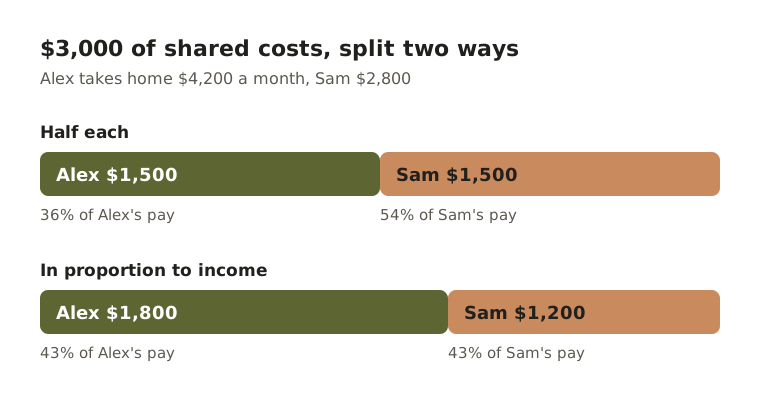
Neither way is the correct one. Pick the one you both find fair, and look at it again when a salary changes, someone stops working for a while, or a child arrives.
Build the shared budget
- Look at what you really spend. Go through the last three months of statements for the accounts that pay shared costs, and add up each category. Our guide to making a monthly budget walks through this step.
- Set a limit for each shared category, close to what you actually spent, then trim one or two.
- Decide what you are saving for together, such as an emergency fund, a holiday or a deposit, and treat that amount like a bill. Sinking funds are a good fit for the big shared costs you can see coming.
- Give each of you personal money. Whatever is left in your own account after your share is yours. Agreeing that this money needs no explaining removes most small arguments.
- Set an "ask first" amount. Many couples agree that any shared purchase above a figure, say $150, gets a quick message before it is made.
Hold a monthly money check-in
Pick a fixed time once a month, keep it to twenty minutes, and go through the same four questions:
- Did the shared costs come in under the limits?
- Is any category over every month, and should its limit change?
- Are the shared savings on track?
- Is anything big coming in the next two months?
Keep it about the plan and not about blame. If groceries run over three months in a row, the limit was wrong.
How Fimerse helps
A Fimerse account holds one person's money and has no shared sign-in for two people, so the simplest setup is for one of you to keep the shared picture in it and bring the numbers to the check-in.
Add the joint account alongside your own, either by typing payments in by hand or by uploading its statement. Set a budget, which is a monthly limit on a spending category, for each shared category such as groceries and utilities. Each budget shows how much of its limit the month's payments have used, is flagged at 80 percent and is marked over once you pass it. When both accounts are in Fimerse, money you move from your own account to the joint one can be linked as a transfer, and linked transfers are left out of spending.
Savings goals track what you are putting aside together, and bills keep their due dates and remind you when one is due soon. You can export your transactions as a CSV file to share with your partner. Accounts, budgets, bills and goals you enter by hand are free; having your bank statements read for you is part of Plus.
Questions people ask
Should we combine everything when we move in together?
You do not have to. Many couples start with separate accounts and one joint account for shared bills, and combine more later if it suits them. Choose the setup you are both comfortable with today.
What if one of us has debt?
Decide together whether it is a shared cost or a personal one, and put it in the budget either way so it is not a surprise. How debts and joint accounts affect each of you depends on where you live, so ask a professional before you combine them.
What if one of us earns nothing right now?
Then a proportional split puts the shared costs on one income for a while. Keep personal money for both of you all the same; it matters most to the person who is not earning.