
"How much should I have in savings?" is one of the most common money questions, and the honest answer is that it depends on you. A figure that is plenty for one person is thin for another. What helps is a way of working it out that starts from your own costs and gives you a number you can actually aim for.
The idea in this guide is to think of savings in layers. Each layer has one job, and adding them up gives you your number.
Start with one figure: your monthly essentials
Everything below is built on what you must spend in a month to keep life running. Not your full spending, just the parts you cannot pause.
- Rent or mortgage, and utilities.
- Groceries, phone and internet.
- Transport to work.
- Insurance and minimum debt payments.
- Childcare and anything else you cannot stop.
Take it from what you actually spent, not from memory. Add these categories up over the last three months of bank statements and divide by three. If some lines are hard to place, our guide to reading a bank statement explains what each one usually means.
For the examples below, say the essentials come to $2,400 a month.
Layer 1: the emergency fund
The first layer is for things you cannot predict: losing your job, an urgent repair, a medical bill. A common rule of thumb is three to six months of essential costs. With $2,400 of essentials, that is between $7,200 and $14,400.
If that feels far away, set a first milestone of one month of essentials. It already covers most small surprises. Our guide to building an emergency fund goes through each step, including where to keep it.
Layer 2: sinking funds for bills you can see coming
The second layer is for costs that are not surprises at all: the yearly car insurance, holiday gifts, the car service. These are called sinking funds. You save a little each month so the money is there when the bill arrives.
This layer matters because it protects the first one. Without it, the insurance renewal comes out of the emergency fund and leaves it short when a real emergency happens. Add up the yearly cost of each known bill to see how big this layer gets at its fullest.
Say the car insurance is $960 a year, gifts are $600 and the car service is $420. That layer peaks at $1,980, though on most days it holds less, because you spend each fund when its bill is due.
Layer 3: your own goals
The third layer is for things you want rather than things you must pay: a trip, a deposit on a home, a new bike. Each goal gets its own target and a rough date. There is no right amount here. It is whatever your goals cost, saved at a pace you can keep.
Say the goal is a $1,500 trip next summer.
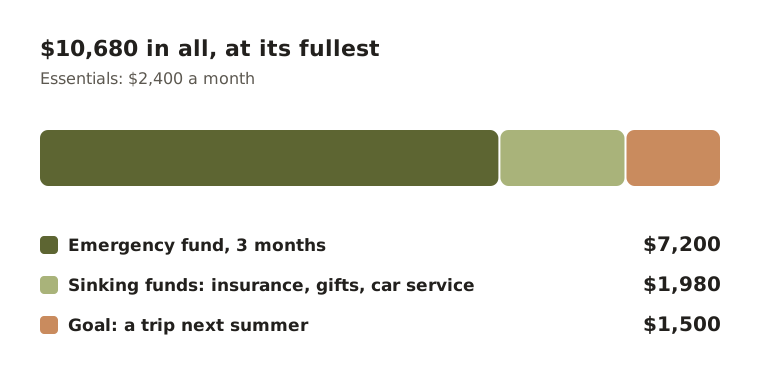
Add the layers up and this example's number is $10,680 at its fullest: $7,200 for emergencies, $1,980 for known bills and $1,500 for the trip.
Adjust it to your situation
The layers stay the same for everyone. What changes is how deep the first one should be.
A steady salary and a second earner
You can usually sit closer to three months. If one income stops, the other keeps essentials partly covered while you find new work.
One income, or people who rely on you
Lean toward six months. There is no second paycheck to fall back on, and the cost of a gap is higher.
Self-employed or paid unevenly
Aim for six months or more, because quiet months are part of the job, not an emergency. Our guide to budgeting on an irregular income shows how to save a share of each payment instead of a fixed sum.
Paid in one currency, spending in another
Exchange rates move, so your essentials can cost more one month than the last without anything changing in your life. A slightly deeper emergency fund absorbs that. Our guide to tracking money in more than one currency helps you see your essentials in the currency you spend.
How long it takes to get there
Divide your number by what you can save each month. Your savings rate tells you what you usually keep. If you keep $500 a month, the example's $10,680 takes a little under two years to fill from zero. That is normal.
Fill the layers in order. A first emergency milestone comes first, then sinking funds for the bills due soonest, then the rest of the emergency fund and your goals side by side.
How Fimerse helps
Fimerse lets you add a savings goal for each layer, with a target amount, and add funds as you save, so a progress ring shows how close each one is. Your savings rate is worked out from your real income and spending, and the spending breakdown by category helps you find your essentials number. Goals, budgets and payments you type in by hand are free; reading your bank statements for you is part of Plus.
Questions people ask
Is there an average amount people have in savings?
Averages exist, but they mix people with very different costs and incomes, so they say little about what you need. Your own essentials are a far better starting point.
Can I have too much in savings?
Once your emergency fund, sinking funds and goals are covered, extra cash may be better used another way. What that way is depends on your situation, so ask a financial professional.